

Dear {{first_name}} ,
We started a series of video interviews and had the honour to host our first guest. Our goal was to add as much value to your professional life and career as possible. Read until the end of this episode and choose our streaming options - your preferred platform should be covered (Apple podcasts will be coming, too).
We do this, because delivering value to you keeps us going. If you like what we do, please like and subscribe on YouTube and Spotify - we know it’s annoying to read but it really helps us grow. For 0$. :-)
Thanks and talk soon,
Pascal
Career Capital: The Assignment Nobody Wants
CPO Path #21 CW 33 2026
EXECUTIVE PREMISE
A career decision may be easier to judge when the question shifts from what the role is called to what the role will teach. The relevant distinction is between advancement that is visible on an organisational chart and capability that becomes portable across employers, categories, and industries.
WHY THIS MATTERS
The Center for Creative Leadership's Lessons of Experience research, now spanning more than three decades, underpins the widely cited 70-20-10 proportion: roughly 70% of leadership development is attributed to challenging assignments, 20% to developmental relationships, and 10% to formal coursework. The same body of work identifies five recurring sources of leadership learning — bosses and superiors, turnarounds, increases in job scope, horizontal moves, and new initiatives ([Center for Creative Leadership], 2025).
Four of those five describe work that is uncomfortable at the time it is offered.
The relational dimension appears equally consequential. McKinsey's survey of 5,774 employees across five countries found the leading reasons for leaving to be relational rather than transactional: not feeling valued by the organisation (54%), not feeling valued by one's manager (52%), and an absent sense of belonging (51%). Employers, asked the same question, tended to name compensation and workload ([McKinsey & Company], 2022).
Read together, the source picture suggests that the two variables most associated with development and with staying — difficulty of the work and quality of the people — are frequently not the variables candidates weigh most heavily when a role is offered.
THE REAL DYNAMIC
In practice, the assignment that carries the most learning is often the one presented apologetically.
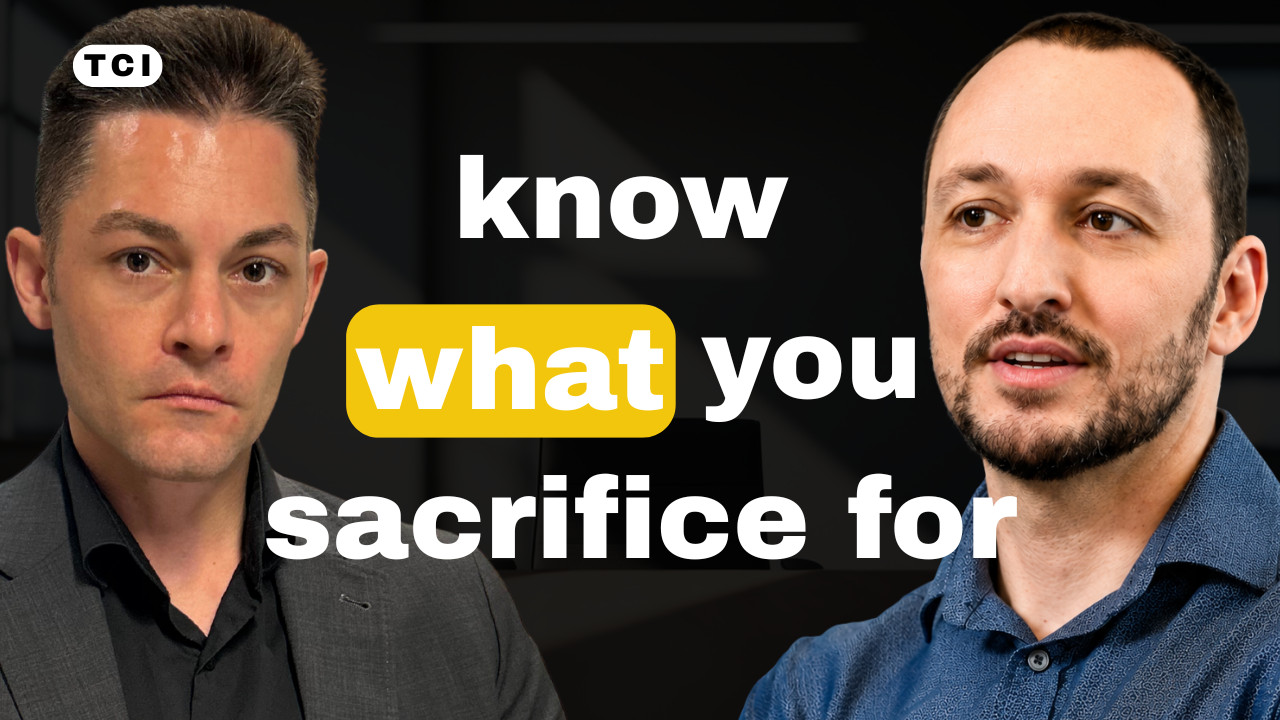
In the first episode of The CPO Interviews, Panos Anastasiou — Chief Procurement Officer at Opella, responsible for €3bn of spend and 111 people — describes a sequence of roles chosen against the apparent logic of a career ladder.
He began in direct materials, running one of the three largest commodity desks in his organisation. His performance, by his own account, warranted the top rating; he consistently received the one below it, with the explanation that he was too outspoken. A senior colleague then suggested he move to indirect procurement — a portfolio he found in considerable disorder, with no volume aggregation and fragmented contracts. He describes it as the best advice he received. What followed was a robotic-process-automation programme, then a solo assignment covering cybersecurity, privacy, and third-party risk that he characterises as a role nobody else wanted. He was promoted to Vice President after it.
The pattern repeats at the next employer. Hired for a North America role in Chicago — relocation planned, schools selected — he was asked instead to take a European position in a smaller market town after an incumbent resigned. He went.
His summary rule, offered after roughly 25 years:
"Shitty job, great people: yes. Diamond job, shitty people: no."
Two qualifications belong beside it, and he raises both himself.
The first is that a single person changed the outcome. In the disordered indirect portfolio he reported to a manager who, in his description, held a mirror up to his behaviour and coached rather than threatened — in contrast to an earlier senior leader who had responded to the same behaviour with an explicit warning about his continued employment. The identical assignment under the second manager may have produced a departure rather than a promotion. This is consistent with the CCL finding that bosses are themselves one of the five principal sources of leadership learning.
The second is that he speaks, in his own words, from a position of privilege — sixteen years of dual income, deliberately modest spending, and financial independence reached some years ago. He describes the resulting freedom as an ultimate BATNA: the capacity to leave at any point. Willingness to accept a difficult assignment is not evenly distributed, because the downside of a failed one is not evenly distributed.
That second qualification has an empirical counterpart. A body of research beginning with Ryan and Haslam finds that precarious leadership positions — those attached to poor prior performance or elevated risk of failure — are disproportionately offered to women and to members of minority groups, a pattern subsequently examined across a decade of studies and a meta-analysis ([Ryan & Haslam], 2005; [Morgenroth et al.], 2020). The advice to accept difficult work therefore reads differently depending on who receives it, and on whether the difficulty was disclosed.
The practical implication may be that "say yes to the mess" is not a rule but a conditional. The conditions are what make it work.
The full conversation
Almost two hours with Panos Anastasiou, CPO of Opella. Uncut, including the parts most executives leave out - for you {{first_name}} !
Watch and follow on YouTube for future interviews:
Audio only:

THE CPO INTERVIEWS
How a CPO Runs €3 Billion with 111 People | Panagiotis Anastasiou
Follow on Spotify:
WHAT STRONG LEADERS DO DIFFERENTLY
One workable approach is to assess an offered assignment against five questions before the title is discussed:
1. Learning rate
What will I be able to do eighteen months from now that I cannot do today — and would another employer pay for it?
2. The people
Who will I report to, and who will I sit beside? Given the relational drivers in the attrition evidence, this may be the single highest-weighted variable, not a tiebreaker.
3. Repair margin
How far is the current state from an achievable state, and is that distance visible to anyone besides me? An estate in disorder offers a large margin. A well-run function offers very little.
4. Attribution
When the result arrives, will it be attributable — and to whom? Difficulty without attribution is cost without capital.
5. Exit condition
What evidence would tell me this was the wrong decision, and by which date? An assignment taken without a review point is difficult to distinguish from one that cannot be left.
The reciprocal obligation sits with the leader making the offer. A difficult assignment is likely to develop someone only when it comes with a stated mandate, protection from the consequences of the inherited condition, a defined horizon, and recognition attached to the individual rather than absorbed by the function. Where those four are absent, the assignment is a staffing solution rather than a development one — and may be better described as such.
CPO PATH DIAGNOSTIC
Question | Fully true | Partly true | Not true |
|---|---|---|---|
My last role change was chosen for what it would teach, not what it was called. | ☐ | ☐ | ☐ |
I can name the person I learned most from in my current organisation. | ☐ | ☐ | ☐ |
The difficult assignments in my team are offered with a mandate and a horizon. | ☐ | ☐ | ☐ |
Results from repair work are attributed to the individuals who did it. | ☐ | ☐ | ☐ |
I know what would tell me my current role has stopped developing me. | ☐ | ☐ | ☐ |
ONE-LINE VERDICT
A difficult assignment may build a career when it comes with capable people, a visible starting condition, and a name attached to the outcome — and may simply consume one when it does not.
Hello {{first_name}}, Do you agree with this episode?
I read every single message, and past posts already shaped this space. Reach out to me and tell me what you’re up to and the path you’ve chosen or post online your thoughts about this episode. I read every email and linked post.
Talk soon,
Pascal

Did this resonate with you?
Quick wins to implement today: helpful structures I use and you should check:
Who should sit in the next chair?
Episode 1 was Panagiotis “Panos” Anastasiou, CPO of Opella. Episode 2 is open.
Which CPO would you want to hear for two hours, uncut? Your own? Someone whose thinking you have followed from a distance? Name them — and if you can make the introduction, better still.
Replies to this email, or write to [email protected].
Currently available: interim procurement
I step in when a procurement function has a gap that cannot wait for a permanent hire: a vacant lead role, a tender that has to reach award, a supplier situation that needs someone full-time, or a new site or project with no sourcing structure yet.
8+ years across direct, indirect and CapEx — USA, Asia, EMEA.
Capacity from September 2026 — or immediately, if the situation cannot wait. Part-time or full-time.
Reply to this email, or write to [email protected].
SOURCES
Center for Creative Leadership. "The 70-20-10 Rule for Leadership Development." 2025. https://www.ccl.org/articles/leading-effectively-articles/70-20-10-rule/
McKinsey & Company. "'Great Attrition' or 'Great Attraction'? The Choice Is Yours." 2022. https://www.mckinsey.com/capabilities/people-and-organizational-performance/our-insights/great-attrition-or-great-attraction-the-choice-is-yours
LinkedIn Learning. "Workplace Learning Report." 2025. https://business.linkedin.com/learn/resources/workplace-learning-report
Ryan, M. K., & Haslam, S. A. "The Glass Cliff: Evidence That Women Are Over-Represented in Precarious Leadership Positions." British Journal of Management, 2005. https://onlinelibrary.wiley.com/doi/abs/10.1111/j.1467-8551.2005.00433.x
Morgenroth, T., et al. "The Who, When, and Why of the Glass Cliff Phenomenon: A Meta-Analysis." 2020. https://journals.aom.org/doi/10.5465/amr.2007.24351856
Thank you for your time and trust,
Pascal Hecker | Editor-In-Chief, CPO Path.